Simarabo [Taíno language]: fugitive.
“Well, the slaves finally couldn't take the whip or slavery any longer. So there was a big dance once. And one man sang: Baja-o, tangi f'i; ma te dei booke, mi a-o!" ("Thank you, o dance; but when the day breaks I'm gone"). The dikitor said, "What's that?!" And he sang: "Banjaa tangi fi-o banjaa. Banjaa tgangi f'i-o banjaa. Kaba doi booko boni-o mi'a -oo..." Well, at daybreak they were indeed gone.” (Fredick Bonaparte)
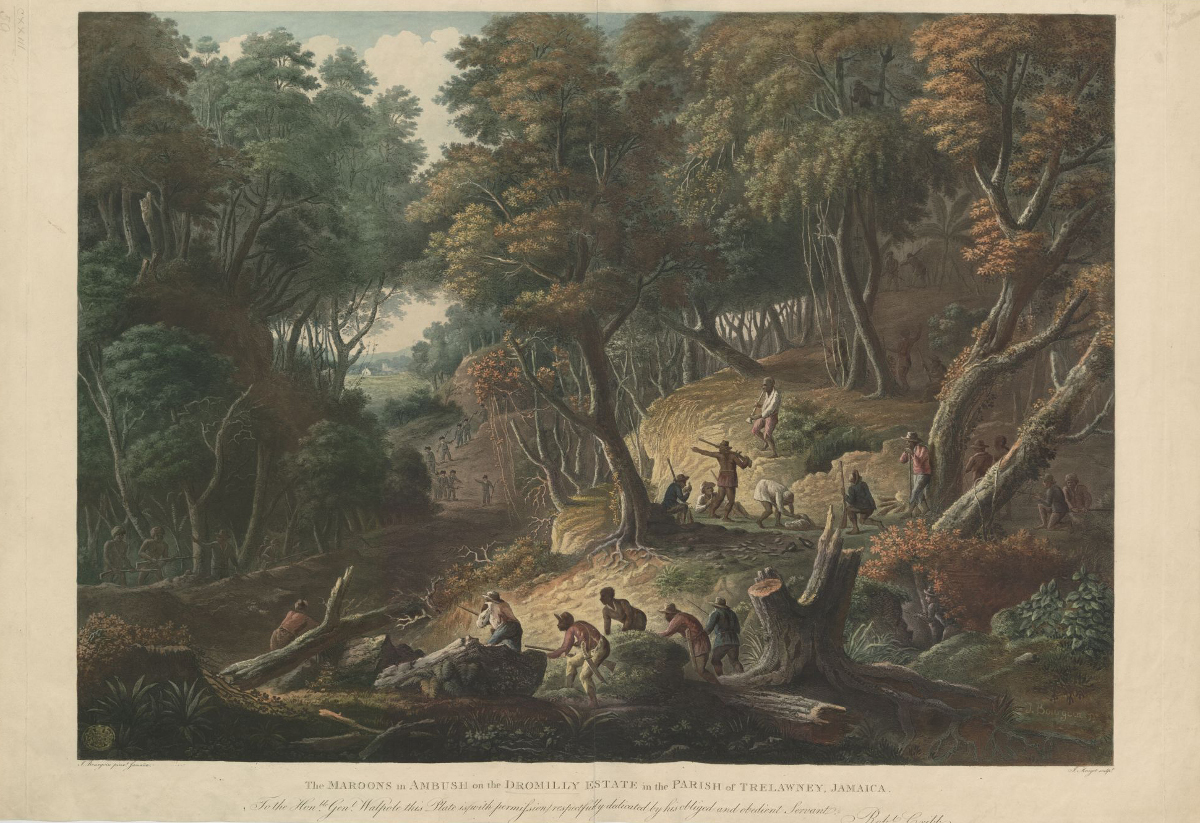
From the very beginning that enslaved Africans were brought to the Americas, there were attempts at running away. The famous English privateer Sir Francis Drake wrote in his chronicles about enlisting fugitive Africans to raid the Panamanian coastline in the 1570s. When fugitives banded together in an attempt to settle in the dense brush-lands of the Caribbean islands, the humid swamps of North America, or the rainforest in south America, these were called Maroons, after the Spanish word cimarrón, believed by some to mean 'feral cattle.' According to Cuban literary scholar José Juan Arrom, the word is derivative from the word simarabo, meaning fugitive in the Arawakan language of the Taíno who once resided in the Caribbean basin, and who sometimes welcomed the African refugees in their communities.
On most of the smaller islands in the Caribbean, the African fugitives faced great odds trying to survive and subsist, and most were eventually defeated and recaptured. The fugitives had better chances at 'marronage' on the larger islands like Jamaica and Cuba, where they could settle in the mountains and more easily remain in hiding, grow crops and increase their numbers, and pose a significant threat to the colonists. Indeed, to this day, Jamaica is home to a sizeable community of descendants from Maroons, who are in possession of land allotted to them in 1739-1740 peace treaties signed with the British.
In Suriname, the enslaved Africans were just as prone to escape as elsewhere in the Caribbean, as illustrated by a quote by an observer from the time of Willoughby's first colony (Price 1973, 23):
These wretched miseries not seldome drive them to desperate attempts for the Recovery of their Liberty, endeavoring to escape, and, if like to be re-taken sometimes lay violent hands upon themselves.
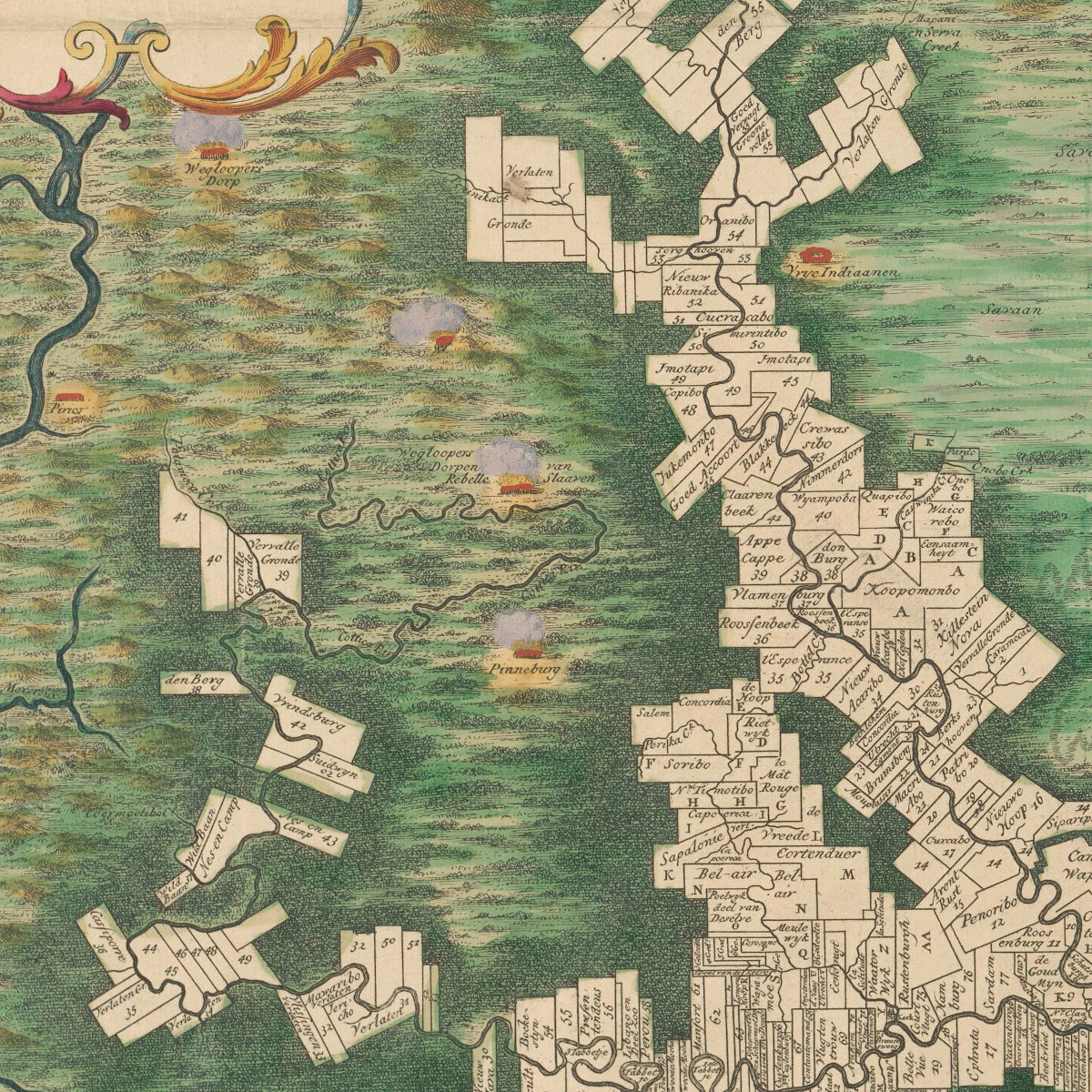
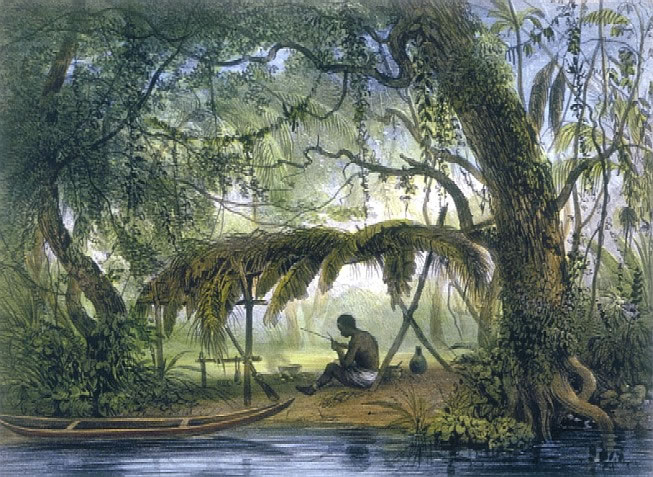
The enslaved who fled from the plantations in Suriname had considerable geographical advantage on their side. The colonial plantations were located along the banks of the rivers proximate to the coastline, buffered by a vast and dense rainforest to the south. This meant that the plantation fugitives were able to escape along the side of the rivers and into the jungle, posing a considerable challenge to the colonists who sought to retrieve them. The Maroons quickly learned to use the harshness of the environment to their advantage for purposes of concealment.
According to the historical record, there were several incidents of marronage during the time of English rule, the most famous of which being a group led to a Coromantee (Akan) man named Jermes, who constructed a fortress in the vicinity of what is now the district of Para, and from there raided nearby plantations.
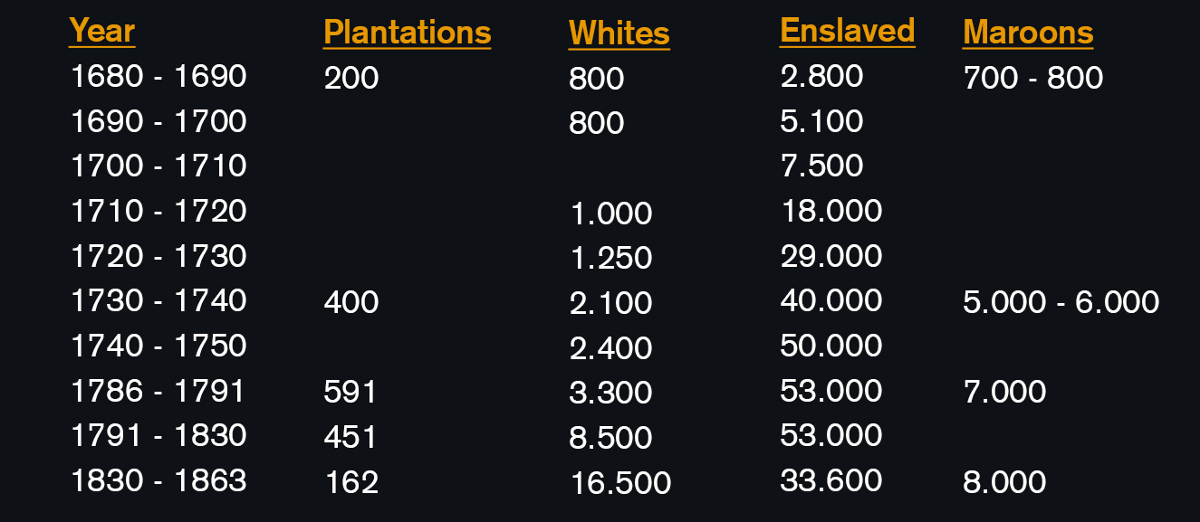
The incidence of enslaved Africans escaping into the forests increased substantially after the Dutch took over and invested in building up the plantation economy, with a subsequent increase of enslaved people present in the colony. In 1679, the colonial governor of Suriname estimated the the number of Maroons to be around 700 to 800, roughly the same amount as whites in the colony. By 1730, that number had increased to 5,000. By contrast, there were around 40,000 enslaved people and 2,100 whites residing on the 400 plantations at the same time.
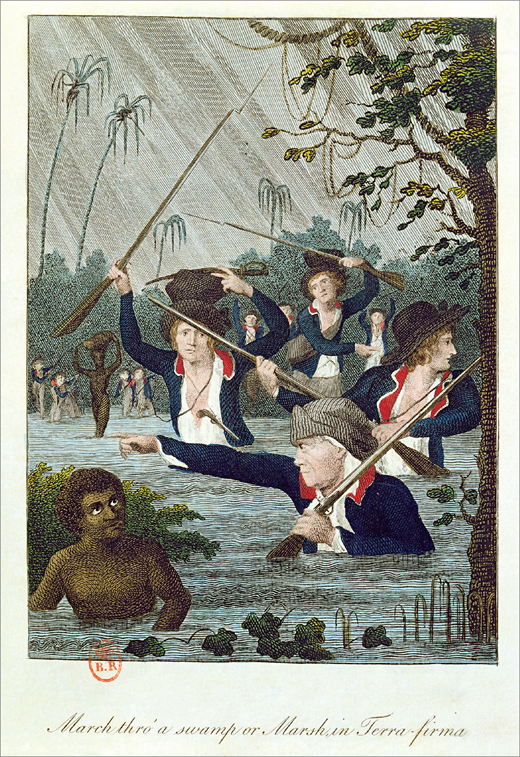
As the number of fugitives increased, so too did the frequency and the intensity of the guerrilla-style raids on the plantations. By the 1680s the colonial administration started to commission expeditions to retrieve the fugitives. After a major plantation uprising resulting in the killing of the owner and the escape of all of the enslaved Africans in the forest, the government instituted a citizens' guard and increased penalties for running away (culminating in a death sentence by 1721) and the rewards for capture. Colonial troops started to embark upon raids into the forests to locate the Maroons, burn down their forest settlements, and return the fugitives back to the plantations.
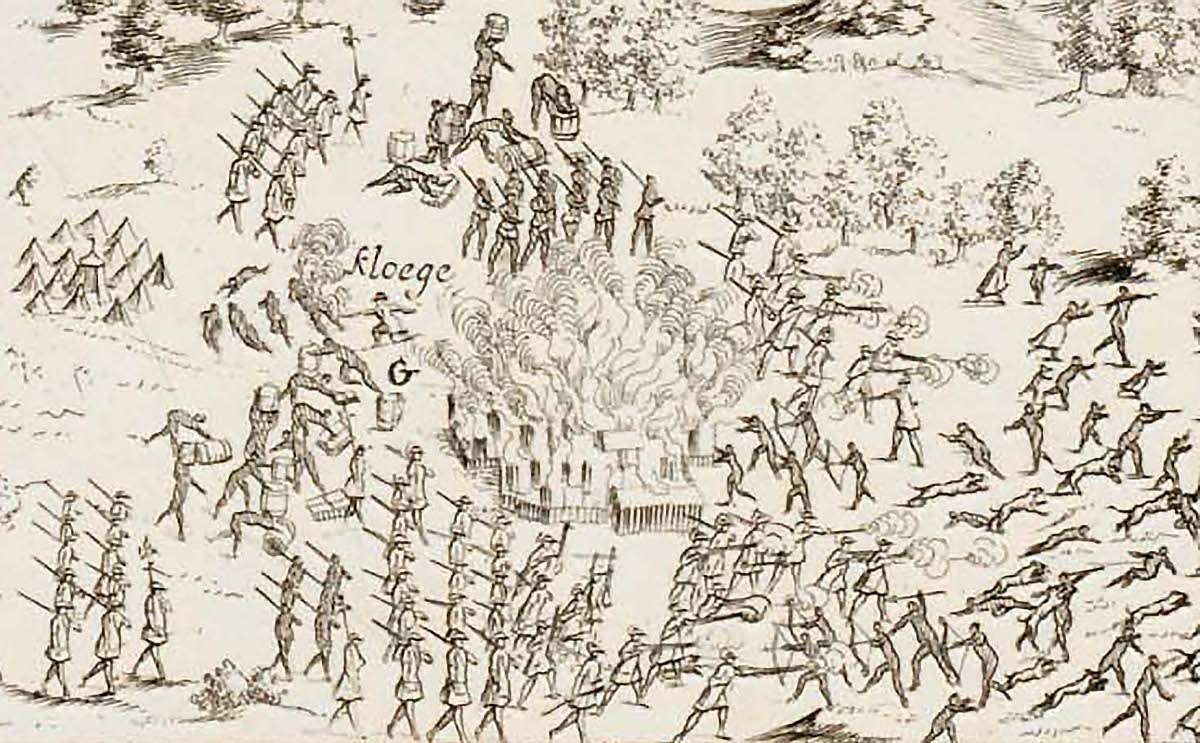
By this time, however, the Maroons had developed significant skills in jungle warfare, and became skilled at ambushing and laying traps for the troops who were trained in conventional tactics in the open battlefields of Europe. Hence, most of these expedities resulted in little to nothing, and the soldiers returned back to Paramaribo in miserable conditions (Helman 1982, 107).
By the 1730s, the military expeditions into the interior reached their maximum frequency, spurring an eighteenth-century historian to describe Suriname as "a theater of perpetual war." (Hoefte and Meel 2001). The colonial administration had no choice but to capitulate. In the 1760s, peace treaties were signed with three of the major Maroon groups: the N'djuka (1760), the Saamaka (1763), and the Matawai (1767).
These treaties stipulated that the Maroons would receive autonomy and the right to exist in the forest, in exchange for a ceasefire and a pledge to refrain from further raids or acts of aggression against the colony. The Maroons initially perceived these treaties with mistrust and aggression, but they later became more receptive as their societies had grown in size and complexity, limiting their mobility and encouraged a more sedentary existence.
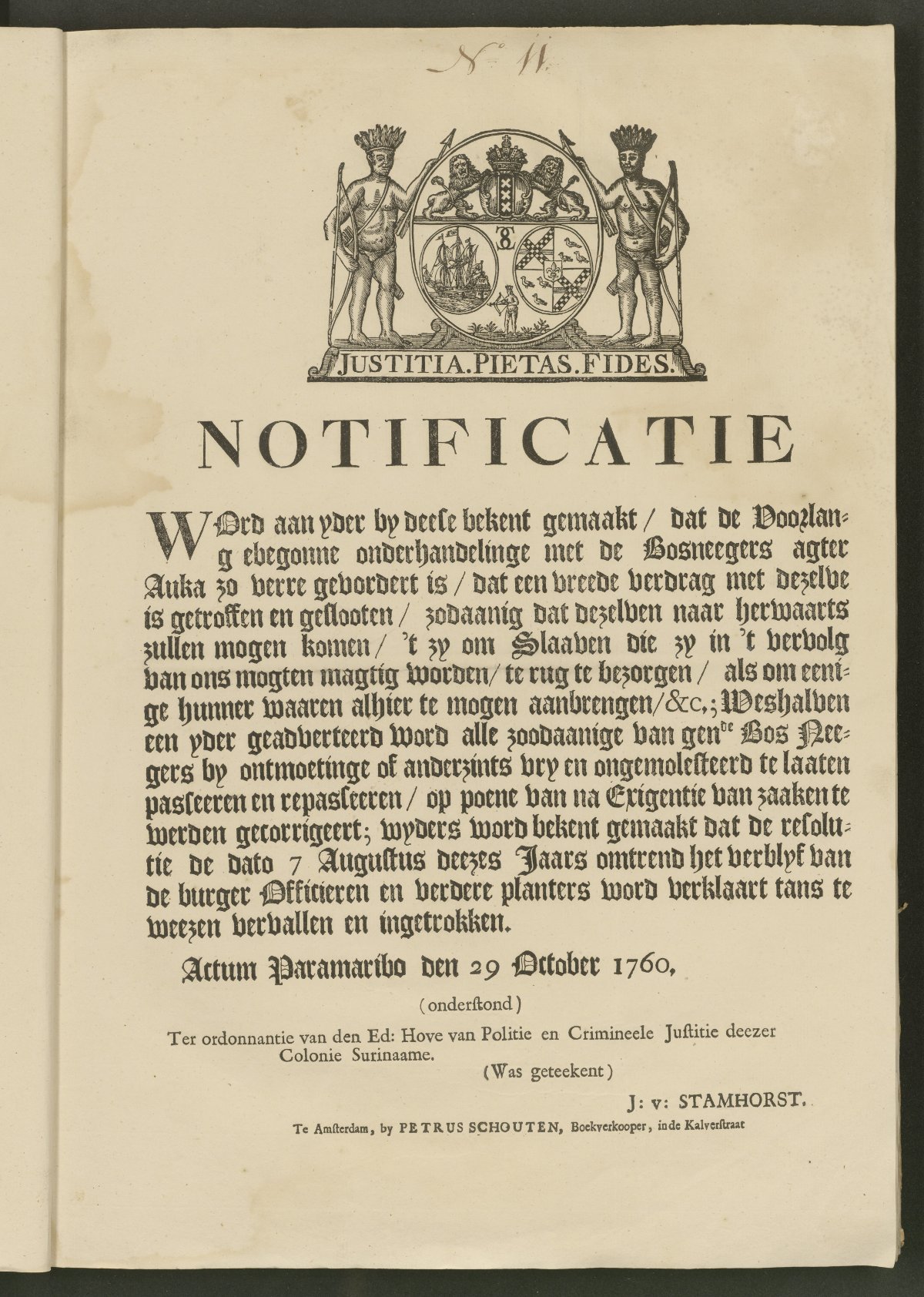
Here we see an official notification about the signed peace treaty, with the N'Dyuka / Aukaner group, from October 29, 1760. It reads:
Is it made known to each and all / that the wickedly-begun negotiations with the Bush Negroes behind Auka is so far advanced / that a broad treaty has been reached and concluded with them / such that they may come back hither / be it to return slaves in the future that have become mighty in our midst / or to deliver certain goods to here / & similar; For this reason, everyone is advertised to permit all such bush negroes pass and return freely and unmolested at encounters or otherwise / or face a fine to be applied after business exigencies have concluded; more widely, it is announced that the revolution that was declared on August 7 this year concerning the residency of the citizen officers and other planters is now essentially cancelled and withdrawn. (View scan in larger detail)
View the first reference to this Aukaner peace treaty in the handwritten records of the Council of the Police, in the digital archives of the National Archives of Suriname and the Dutch National Archives.
Both courtesy of the National Archives of Suriname.
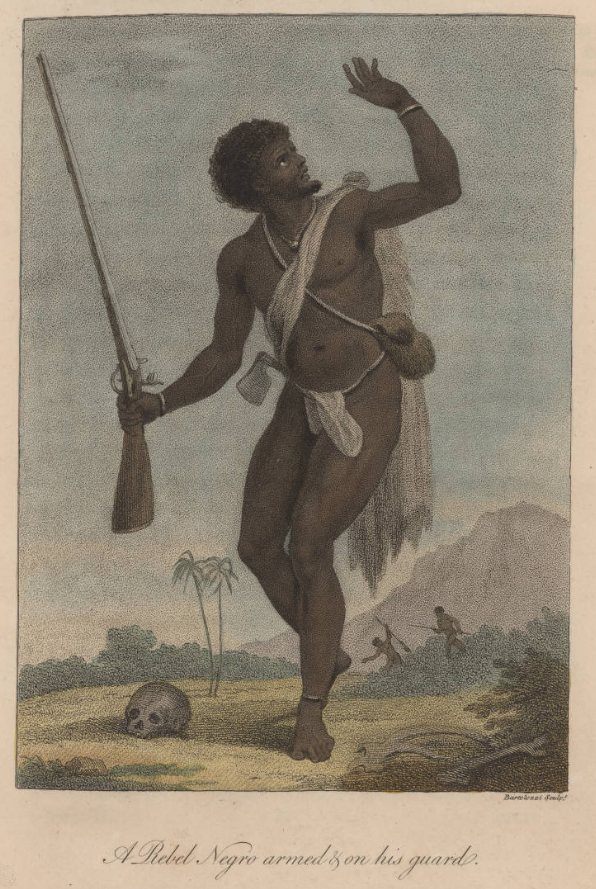
While the majority of the Maroons would largely keep to the treaties, groups of fugitive Africans continued to pose a threat. Later, towards the end of the 18th century, the colonial government in Suriname armed a group of enslaved men whom they trusted, called the Redi Musu (red caps), to fight against their own kin, most famously in the Boni Wars (1765-93) in the eastern part of Suriname.
Eventually, there came to be six main groups of Maroon cultures: the Kwinti, the Matawai, the Saamaka, the N'djuka (or Aucaner), the Paamaka, and the Aluku (or Boni).
The Matawai and Saamaka speak a Portuguese-based creole language, taken by scholars to be an indicator that their ancestors were among the first to flee because Portuguese was a more prevalent language in the earlier days of the colony, and Portuguese Jews were among some of the earliest buru (white farmers) in Suriname. The remaining Maroon groups speak an English-based creole language, similar to the Surinamese lingua franca Sranan-Tongo which consolidated later on in the history of the colony.
According to the Maroon scholar Richard Price, following the peace treaties "for the next hundred years these societies were allowed to develop more or less in isolation, yet they always remained dependent on coastal society for certain manufactured items, from cloth and pots to axes and guns" (Price 1976). From then onward, the Maroons were able to develop their own cultures, which is described by Price and others as a process of syncretism and creolization ─ a dynamic and creative adaptation of shared and hybridized African heritages, together with facets of plantation social life and influence from the indigenous communities, to make sense of an entirely new reality in the South American rainforest. Their worldview became imbued with an almost mythological sense of historical memory and consciousness about slavery, and the early days when their ancestors became free.

For more Amazon Conservation Team Storytelling Maps, please visit our website at amazonteam.org.
Sources
Cover: "Slave rebellion leader Boni." Engraving by William Blake, published in John Gabriel Stedman's Narrative of a five years expedition against the revolted Negroes of Surinam (1796).
Cartography and design by Rudo Kemper.
We are grateful to Carl Churchill and Rita Tjin Fooh for reviewing and providing feedback on drafts.